| Art &Technology |
|
| - Marcel Duchamp - Movement |
A problem not
only Duchamp was working on in the 1910s was the problem to introduce movement
into painting.
|
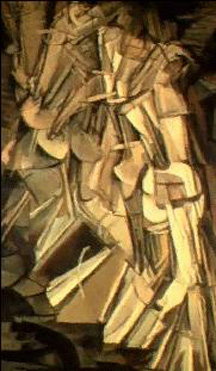
Marcel Duchamp: Nude Descending a Staircase. 1912 |
Fig.: Muybridge: Study
|
|
Duchamp's relation
with the Cubists was shot through with conflict, as seen in the objections
that led to his withdrawal of his Nude Descending a Staircase from the
28th Salon des Indépendants, which was held in Paris in February
1912. This work however was to make him famous when shown the following
year in New York at the Armory Show. Duchamp's solution to the problem and an invention of his own was a series of moving objects, the "rotoreliefs" as he called them. The rotoreliefs provided a visual experience of moving objects, which were visual objects and machines at the same time. The idea was to present an object which is not to be understood as a static object as paintics are, but rather a machine in action. Duchamp's studies in mathematics and engineering might led him to the concept of kinetic sculptures, which were extremely influential on artists as: And
later on in the 90ies then
|
Amongst the artists influenced by Duchamp were many Futurist painters like Balla, e.g. who found his personal solution in paintings like "The Rhythm of the V".