| Art &Technology |
|
| - Marcel Duchamp - Rotoreliefs |
One of Duchamp's
main concerns was the problem how to introduce movement into painting.
|
Marcel Duchamp: Rotoreliefs. 1920 |
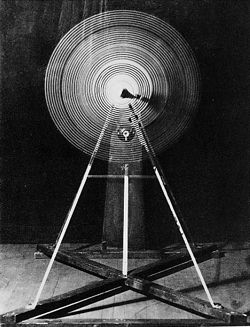
Fig.: Duchamp: Rotorelief
Fig.: Duchamp: Rotative Plaques, glass, metal, motor, 1920
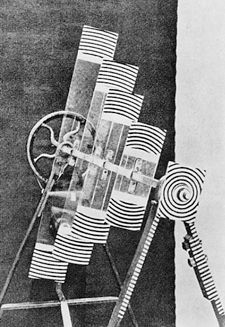
Fig.: Duchamp: Rotative Panels, glass, metal, paint, 1920
|
|
Duchamp's
solution to the problem and an invention of his own was a series of moving
objects, the "rotoreliefs" as he called them. The rotoreliefs
provided a visual experience of moving objects, which were visual objects
and machines at the same time. The idea was to present an object which
is not to be understood as a static object as paintics are, but rather
a machine in action. Duchamp's studies in mathematics and engineering
might have led him to the machine-like
look of the objects.
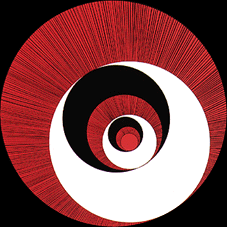
The Rotoreliefs were first shown at opening of the 33rd "concours lepine, salon des inventions", at the Parc des expositions, Porte de Versailles. Duchamp has taken a tiny stand of three square meters to exhibit Rotoreliefs. In a joint venture with Henri Pierre Roche, 500 sets of six colored disks have been produced and were designed to be placed on a gramophone. Turning at the certain speed the disks give an impression of depth, Duchamp suggested that the optical illusions becomes more intense when viewed with one eye only.
|
Situated in alley F, stand number 147, some of the disks were turning horizontally and some vertically. Sandwitched between incinators and a rubbish-compressing machine on the left and an instant vegetable chopper on the right, Duchamps invention, which is awarded an "honorable mention" in the industrial art categoly, goes practically unnoticed by a public whose interest is in a serch for more practical and useful gadgets.
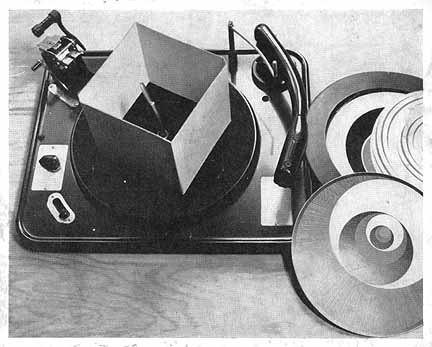
Fig.: Marcel Duchamp:
Rototoreliefs, reproduction/ reconstruction, 1955
© 2001 Succession Marcel Duchamp, ARS, N.Y. / ADAGP, Paris.
Wall hanging units were later foblicated on the occasion of 1965 Milan reproduction. It consists of a wooden box (37.5 x 37.5 x 8.5 cm) which is covered with black velvet; the motor is behind, in the center of the box, and drives a revolving magnetized turntable which enables one to use, according to the disks to be shown, either one of the two circular magnetised black flames of different width supplied with this unit.

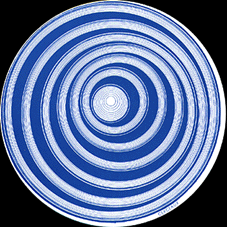
Fig.: Marcel Duchamp:
Rototoreliefs, reproduction/ reconstruction, 1955