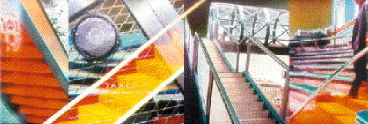
 Steps (scales) as an element of sound architecture.
LINK project by Mathias Fuchs and Sylvia Eckermann
Steps (scales) as an element of sound architecture.
LINK project by Mathias Fuchs and Sylvia Eckermann
It is tempting to want to liberate Marioni's statement, "Sound is a malleable material of sculpture"1from the very compact and plastically intended idea of a sound object and expand it towards the idea of sound architecture. This would make sound the building material for constructing acoustic buildings: sonorous cathedrals, sound garages, multi-timbral halls, intimate rooms. Even the words indicate that music may be read architectonically. Notes are high or low. Melody figures rise or fall, sounds have volume, or they are flat. One medium's (music's) terminological mining of another (architecture) may also be usefully reversed. Architecture may be read in the terminology of music, and it may be written in the terminology and concepts of music. Walls, gates and furniture may be constructed just as well from sound as from stone, steel or wood. (Bernhard Leitner's sound furniture, his sound gate and his sound-rooms may be considered evidence of this.)2
Using architectonic elements and means of communication, such as steps to take just one example it is possible to demonstrate how architectonic structures may be sonorously formed or even substituted. The project series "LINK" (Fuchs/Eckermann, 1994 Bozen, Vienna, Helsinki)3 took staircases from historically and architecturally different contexts and planted them in a para-real soundcase, which deconstructed the real staircase with the mediated staircase. In addition to the physical activity, climbing stairs also always means experiencing the structure of a space and the structure of a material. I can use my eyes to perceive the difference between a creaking wooden staircase and a polished marble staircase, but I can also use my ears or my sense of touch. Media architecture means rewriting this connection. If I provide the ear with spatial conceptions that differ from those provided to the eyes, provide the skin with material conceptions different from those provided to conscious awareness, then I am playing polyphonously on the keys of human perception. With this intention, we altered the way in which climbing the stairs is experienced in comparison with the way it is remembered. The staircase of Kunsthalle, which is remembered as a metal staircase, hard, echoing and physically vibrating, was overlaid with sound material that presented itself as being, in comparison, soft, dull and springy. Then we interrupted these sounds to make room for synthetic stepping patterns. Interactive switching enabled the computer/ sampler system to react to the people climbing the stairs.
The purpose of the sound research area at the Archimedia Institute is to approach one possibility using two strategic tracks: sound and spatial construction are to be not only metaphorically, but also technically and aesthetically materialized. The development of the strategic tracks is based on the starting positions of the fields of music and architecture:
1. How do I build spatial structures from sound?
2. How can I intone buildings?
For the musician (1), the question is how temporal structures may be made into spatial structures. Historically, this question has been repeatedly explored using pre-electronic means. In his "Musiksoziologie"4 ("Music Sociology"), Kurt Blaukopf maintains that the spatial experience of the fine arts and architectural art has always been correlated to the spatial experience of music (e.g. verticality of the gothic in Schütz' music, the invention of the central perspective in painting and of harmonic depths in music at the same time). Using stereophonic, quadrophonic and surround techniques, the entertainment industry attempts to approximate the simulation of space. Yet sophisticated research and development are needed to transfer the historical conceptions into the present and further develop them, as well as to overcome the limitations of commercial systems. Within the framework of the Archimedia Institute, we are exploring sound architecture as one possibility of transmedial irritation and enrichment. This does not so much involve a universal cinema system or an artificial general method, but rather studies in the contexts of actual projects compiling special solutions for a repertoire of possible space generators.
For the architect2, sound presents itself as an immaterial building material that may help to structure, limit and focus architectonic spaces. In this context, we are studying historical concepts (such as the sound sculptures of fountains in oriental gardens, material structures of staircases, passages, ramps), but we are also experimenting with models, with building structures, and in the simulation of sound-architectonic methods.
This last aspect, the simulation of sound architecture using the computer, indicates the particular significance of sophisticated computer systems in the research field of sound architecture. As a universal tool, the computer represents the synapse at the point where sound and architecture meet; between the semantically anchored fields of music and the three-dimensional structure, the machine, as a semantically indifferent bonding agent, takes a key position: it is the catalytic superglue for sound and space.
Acknowledgements:
1. Mathias Fuchs: Musik im Raum. Zeitschrift ÖMZ 6/1986
2. Bernhard Leitner: Le Cylindre Sonore. Aedes Gallery for Architecture and Space, Berlin 1990.
3. Minna Tarkka (Ed.) ISEA Catalogue Helsinki 1994
4. Kurt Blaukopf: Musiksoziologie. Arthur Niggli Verlag Niederteufen 1972.