| Art &Technology |
|
| - Pop Art - Painting |
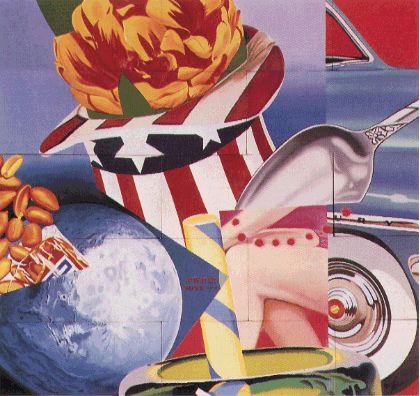
Consumerism was the key target for many Pop Art painters and sculptors.The way they attacked consumerism was a way the French post-structuralists would later on describe as "affirmative negation", which means that they took the object of criticism and instead of descibing it explicitely as being negative they represented it in the most positive manner, almost as if they wanted to advocate or advertise it.
|
James Rosenquist: World's Fair Mural. 1964 |
Fig.: James Rosenquist: World's Fair Mural. Oil on Masonite, 240 x 240 inches, Frederick R. Weisman Art Museum, University of Minnesota. 1964. The original work was commissioned by architect Philip Johnson in 1963, as a mural for a building at the New York World's Fair. |
|
"I'm amazed and excited and fascinated about the way things are thrust at us...we are attacked by radio and television and visual communications...at such a speed and with such a force that painting now seem(s) very old fashioned...why shouldn't it be done with that power and gusto [of advertising], with that impact?" (James Rosenquist) During the 60ies and
70ies James Rosenquist, Jasper Johns, Robert Rauschenberg Rauschenberg,
Roy Lichtenstein, Claes Oldenburg, Andy Warhol and Mimmo Rotella all produced
works showing one or more objects which would be connotated to American
products of the street and the supermarkets. The American flag, "The
Stars and Stripes", as they call it was another icon which made its
way into may of those paintings. Again "affirmative negation"
is the term which describes the semantic game taking place here.
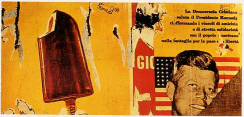
Fig.: Mimmo Rotella: Omaggio al Presidente. 1963 In the field of popular music very much the same process of affirmative negation can be visible (or audible) in works like Jimi Hendrix's "Star spangled banner." |