
The White Album's original working title was A Doll's House, which
is the name of Henrik Ibsen's masterpiece play written in the 19th century.
In addition, according to The Beatles Album by Geoffrey Giuliano,
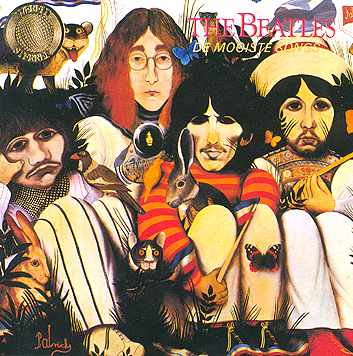
an illustration was prepared for the cover of A Doll's House by
the famed artist Patrick but the plain white cover was opted for instead.
This illustration eventually showed up on EMI's Dutch release of the Love
Songs album, De Mooiste Songs.
The Beatles was released in the UK on November 22, 1968 as Apple
PMC 7067-8 (mono) and PCS 7067-8 (stereo) and in the US on November 25,
1968 in stereo as Apple SWBO 101. The White Album was not released in mono
in the US.
White Album Facts
Recording sessions for the White Album started with the song Revolution
on May 30, 1968, and concluded with take three of Julia
on October 13, 1968. Mixing for the album was completed five days later
on October 18, 1968.
This album marked the first on the then newly formed Apple label, which had made its first appearance as a 45 three months earlier on August 30, 1968 with the Hey Jude/Revolution single, both of which were recorded during the White Album sessions.
Also recorded during the White Album sessions were What's the New Mary Jane and Not Guilty. These two tracks were only available on bootlegs for many years, but were finally released legitimately for the first time 28 years after they were recorded on Anthology 3 in 1996.
The Guiness Book of Records lists The Beatles as having sold "nearly two million" copies in it's first week of release in the US.

Goodies

Four 8x10 glossies, one of each Beatle, were included as inserts with the White Album. These pictures were taken by photographer John Kelley in the autumn of 1968.


Silly Censorship
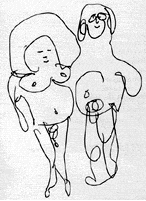
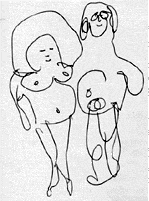
In the United States, one small photograph of Paul and one small drawing of Yoko and John in the poster that was included with the White Album were censored.
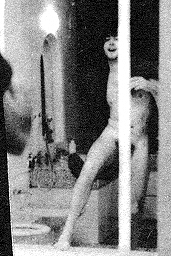
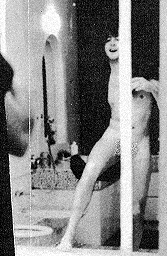
On the left are scans from a copy of the White Album poster included with a White Album manufactured by EMI in Germany. On the right are unretouched scans of the same places on the poster from a copy made by Capitol in America.
Oddities and Rarities
Even with the release of the Anthology series, there are still many
recordings in the EMI vault that have not been released. Here are some of
those which offer us a peek behind the scenes of the making of the White
Album.
- Ob-La-Di, Ob-La-Da
- Over the course of the White Album sessions, many different recordings
of this song were made in several different styles. Assistant recording
engineer for the session Richard Lush recalls that after four or five
days of redoing the song, John in desperation finally went to the piano
and sharply banged out the first few notes of the song. He liked it,
they went with it, and that's the take they released. Here is a sound
clip of that actual moment, from the Peter Sellers Tape.
There are many differences between the Stereo and Mono versions of The White Album. Here is a sound clip of the beginning of the Mono version of the song, which is missing the hand clapping that can be heard in all other mixes of the song.
- While My Guitar Gently Weeps - The Lost Verse
- In this clip of the original demo of the song,
George sings a verse that was not included in the final released version.
Later, in studio take 1, the verse has evolved slightly. But it still did not make it to the final release.
- Martha My Dear
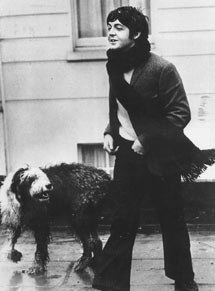
- This is Paul playing the piano part of
Martha My Dear while discussing rock 'n roll chords during downtime
of the Let It Be sessions.
Paul and Martha
Black Bird- Another behind the scenes look at a White Album song from the Peter Sellars Tape,
in this clip you can hear a few seconds of the beginning of the song
that was trimmed off on the album.
- Why Don't We Do It In The Road?
- Like the Mono version of Ob-La-Di, Ob-La-Da, on the Mono version
of this song, the beginning is missing the hand clapping.
While fooling around on the set of Let It Be, John improvises these alternate lyrics for the first line of the song. He'd probably just had breakfast.