| Art &Technology |
|
| - Dada |
On Saturday February 3,
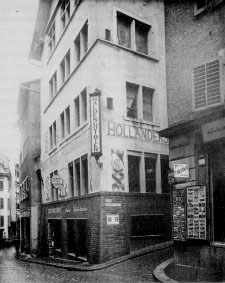
1916 was the inauguration of the Cabaret (Café) Voltaire, an 'artist-tavern'located
at Spiegelgasse 1 in Zurich.
Hugo Ball made an agreement with the owner of the tavern 'Meierei' to use the
backroom for a literary cabaret and to increase the sale of beer, sausages and
sandwiches. They announced an evening with music, dance, manifestos, theory,
poems, pictures, masks and costumes presented by Hugo Ball, Emmy Hennings, Marcel
Janco, Tristan Tzara, Georges Janco and Hans Arp.
Dada (French: "hobby-horse")
soon became a nihilistic movement in the arts that flourished primarily in Zürich,
New York City, Berlin, Cologne, Paris, and Hannover. Several explanations have
been given by various members of the movement as to how it received its name.
According to the most widely accepted account, the name was adopted at Hugo
Ball's Cabaret Voltaire, in Zürich, during one of the meetings held in
1916 by a group of young artists and war resisters that included Jean Arp, Richard
Hülsenbeck, Tristan Tzara, Marcel Janco, and Emmy Hennings; when a paper
knife inserted into a French-German dictionary pointed to the word dada, this
word was seized upon by the group as appropriate for their anti-aesthetic creations
and protest activities, which were engendered by disgust for bourgeois values
and despair over World War I. A precursor of what was to be called the Dada
movement, and ultimately its leading member, was Marcel
Duchamp, who in 1913 created his first ready-made (now lost), the "Bicycle
Wheel," consisting of a wheel mounted on the seat of a stool.
In 1915 - at the beginning of World War I - Hugo Ball (writer and theatre director)
came with his female partner Emmy Hennings (dancer and chanteuse) from Munich
to Zurich. Hugo Ball wrote: “I didn't love the death-hussars,
And not the howitzers with girls' names,
And at the end when the great days came,
I went discreetly away.”
Despite of World War I, the atmosphere in Zurich was very liberal. In the same
narrow alley, Spiegelgasse 14, where the Cabarat Voltaire played, lived Uljanow
aka Lenin. But the authorities were much more suspicious about the chaotic dadaists
than of these quiet, studios Russian Revolutionaries.
|
Hugo Ball, Jean Arp, Richard Hülsenbeck, Tristan Tzara, Marcel Janco, and Emmy Hennings: Cabaret Voltaire 1916 |
Fig.: Cabaret Voltaire at Spiegelgasse 1
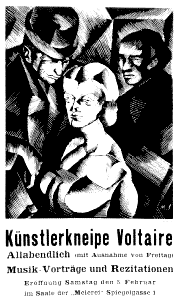
Fig.: Poster for "Künstlerkneipe Voltaire" by the ukrainian painter Marcel Slodki.
|
|
The only edition of
the magazine Cabaret Voltaire was published on June 15, 1916. |