| Art &Technology |
|
| - Marcel Duchamp |
"What I have in mind is that art might be good, bad or indifferent; however we have to call it art no matter what adjective we use; that thus bad art is art in the same sense as a bad feeling is still a feeling."
(Marcel Duchamp: The Creative Process. 1957)
|
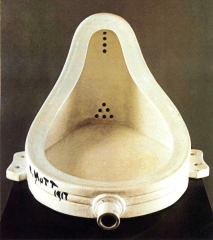
Marcel Duchamp: Fountain. 1959 |
|
|
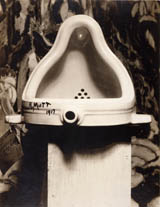
What is it then that distinguishes the offer of art 'Fountain' from the functional product urinal? Visible changes that were carried out by Duchamp and appear as material language, are the signature (R. Mutt 1917), the presentation (the backside lying on a pedestal - compare with the historical photo by Stieglitz for the journal 391), the place of presentation (not a sanitation shop-window, not a washroom - but an exhibition, museum - compare to a picture of Marcel Duchamp where he sits in front of the object in the Pasadena Art Museum, Los Angeles 1963), the giving of the title as information about the context. The gesture of exhibition is appropriate for art; the declaration of the object as a work of art conveys (as immaterial language) the respective receptive impulse. That the realisation of the gesture (the opportunity for exhibition) is a crucial factor of the artistic language, was made apparent by Duchamp in an ironic and provocative way: his object that he anonymously submitted to the committee of the 'Society of Independent Artists' was rejected in 1917. It was only exhibited (and accepted) when Duchamp (who himself belonged to the board of the committee) became known as its originator. The (general) acceptance of Duchamp is transferred to the object and makes it possible (through the reaction of the recipient) that an 'artistic aura' is bestowed on it." (Dietrich Grünewald, Institute for the Theory of Arts, University Koblenz-Landau, Germany) |
On the occasion of an exhibition in the Walker Art Center in 1965, Martin Friedman had an interview with Marcel Duchamp.
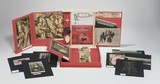
Fig.: Duchamp, Marcel, de ou par Marcel Duchamp ou Rrose Sélavy
(Boîte-en-Valise)
(From or By Marcel Duchamp or Rrose Sélavy [Box in a Valise]), 1941/1966,
glass, vinyl, lithographs on paper, ceramic, wood, cloth-covered board. Collection
Walker Art Center, Gift of Ann and Barrie Birks, 1994
Martin Friedman, Walker
Art Center director interviews Marcel Duchamp on the occasion of the exhibition
Not Seen and/or Less Seen of/by Marcel Duchamp/Rose Selavy on the 18th October
of 1965.
1. On
Revolutionary Spirit, 1965 (3:24) 
2. On Humour, 1965 (0:47)
2. On
the Idea of a Ready-Made, 1965 (3:07)
Marcel Duchamp was born
in 1887, in Blaineville, and died in 1968, in Neuilly. His early work ranged
through all the styles of the times, from post-Impressionism to Fauvism, and
then to work that seems to relate both to Cubism and to Futurism, even though
he himself declared that his interests lay elsewhere. His relation with the
Cubists was indeed shot through with conflict, as seen in the objections that
led to his withdrawal of his Nude Descending a Staircase from the 28th Salon
des Indépendants, which was held in Paris in February 1912. This work
however was to make him famous when shown the following year in New York at
the Armory Show.
Duchamp, moreover, was not really happy as a painter; or he knew that the investigation
of his own most basic concepts and presuppositions required a series of instruments
much more radical than anything painting could offer. He therefore decided in
1913 to abandon painting, and turned his attention for the next ten years to
his "Large Glass, The Bride Stripped Bare by Her Bachelors, Even",
which he definitively declared unfinished in 1923.
Duchamp is of course most famous as the man who drew a mustache and goatee on
the Mona Lisa, then to complete the affront by adding a salacious caption: L.
H. O. O. Q. (which reads Elle a chaud au cul). Or he's the man who mounted a
bicycle wheel upside down on a kitchen stool, or who turned a bottle dryer or
a urinal or a snow shovel into a work of art, simply by deciding that this is
what he wanted them to be. Still today, such gestures are often described as
provocations, though surely it's hard to say just whom they might have been
intended to provoke. Duchamp's audience was extremely small, and he exhibited
his work as little as possible. He speaks of L. H. O. O. Q. as a kind of Dada
joke, perpetrated with Picabia's col-laboration and published on the cover of
Picabia's magazine 391, and surely the urinal "Fountain" was sent
with malice aforethought to the exhibition in 1917 of New York's Society of
Independent Artists, yet still the fact remains that the history of his various
Ready-mades is largely a history of the ways in which they went astray. The
originals of the Bicycle Wheel of 1913, the Bottle Dryer of 1914, the snow shovel
In Advance of the Broken Arm of 1915, the urinal Fountain of 1917, the Underwood
"Traveler's Folding Item" of 1916 have all been lost, and the same
holds true of much of the rest of this period of Duchamp's work. Though vastly
admired by the Dadaists and Futurists, he was mainly famous, up until the 1940s,
for his public renunciation of art in favor of playing tour-nament chess.
Further Reading:
Cabanne, Pierre: Duchamp & Co, Paris 1997
Daniels, Dieter: Duchamp und die anderen. Der Modellfall einer künstlerischen Wirkungsgeschichte in der Moderne, Köln 1992
Fischer, Alfred M., Daniels, Dieter (eds.): Übrigens sterben immer die anderen. Marcel Duchamp und die Avantgarde seit 1950, Köln 1988
D'Harnoncourt, Anne and McShine, Kynaston (ed.): Marcel Duchamp. New York 1973 (München 1989)
Molderings, Herbert: Marcel Duchamp, Frankfurt/M. 1983
Schwarz, Arturo, The Complete
Works of Marcel Duchamp (1969): London, New York 1995